About Buildkite
Buildkite is a CI/CD platform that orchestrates pipelines in the cloud while running builds on self-hosted agents in your own infrastructure or on Buildkite's hosted Linux and macOS agents. It adds Test Engine for flaky-test detection and test analytics, Package Registries for artifact management, and dynamic pipelines that can be generated at runtime. Teams such as Shopify, Uber, and Reddit use it to run large monorepo and mobile builds at high concurrency.
Pros & Cons
Pros
- Hybrid model keeps code and secrets on your own build machines while Buildkite runs orchestration
- Scales to very high concurrency, which suits large monorepos and Bazel-heavy builds
- Dynamic pipelines replace sprawling static YAML with steps generated at runtime
- Plugin system is easy to extend, and reviewers report teams writing their own plugins safely
- Built-in Test Engine detects and manages flaky tests without a separate tool
- Strong documentation and responsive support, with a 4.8/5 average on G2
Cons
- Steep learning curve given how much of the setup is customizable
- Self-hosted agents mean you manage and pay for your own build infrastructure
- Per-active-user Pro pricing plus agent and vCPU-minute charges can add up for larger teams
- Free plan caps at 5 users and 10 concurrent jobs
- Smaller review base and community than GitHub Actions or GitLab CI
Key Features
Self-hosted agents
Run build agents on your own machines, cloud accounts, or Kubernetes clusters while Buildkite handles orchestration, so source code and secrets stay in your infrastructure.
Hosted agents
Fully managed Linux (AMD64, ARM64 on Enterprise) and Apple Silicon M4 macOS agents billed per vCPU minute, metered to the second.
Dynamic pipelines
Generate and modify pipeline steps at runtime from code, so builds adapt to what changed instead of relying on large static YAML files.
Test Engine
Test analytics and flaky-test detection across unit, integration, and end-to-end suites, with workflows to quarantine, assign, or route flaky tests for resolution.
Package Registries
Store and serve packages and container images across ecosystems, with a private container registry on Enterprise for supply-chain control.
Mobile Delivery Cloud
Preconfigured macOS build environment for iOS and Android pipelines, from tests to app store delivery.
Plugins
Reusable pipeline plugins for Docker, caching, test collectors, and more, which teams can also write themselves.
MCP server and AI components
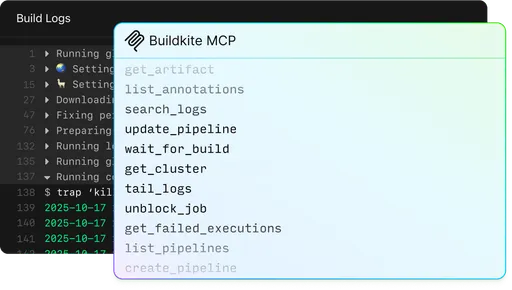
An MCP server that exposes pipeline and log data to AI tools, plus building blocks for triggering builds and connecting LLM providers in pipelines.
Enterprise security
SCIM, custom SAML and ADFS, audit log exports, private log and artifact storage, and SIEM/EventBridge integrations on the Enterprise plan.
Pricing
- Up to 5 users
- Up to 10 concurrent jobs
- 2,000 Linux vCPU minutes per month
- 250k test executions per month
- 30-day build retention
- Dynamic pipelines
- Community support
- Up to 50 users
- 10 concurrent agents included, up to 250 at $3.50/agent/month
- 4,000 Linux vCPU minutes per month
- macOS agents and larger machine sizes
- 1M test executions per month
- 90-day build retention
- Priority email support
- Unlimited users (30 user minimum)
- Unlimited self-hosted agents with volume discounts
- Linux ARM64, largest machine sizes, private container registry
- SCIM, custom SAML and ADFS, audit log exports
- 1-year build retention and historical export
- 99.95% uptime commitment and SLA-backed support with Slack Connect
Best For
Replacing Jenkins at scale
Platform teams move off self-managed Jenkins servers to a hosted control plane while keeping builds on their own agents.
Monorepo and Bazel builds
Dynamic pipelines and massive parallelization run only the steps a change affects across very large codebases.
Mobile CI/CD
iOS and Android teams use hosted M4 macOS agents and caching to cut build and queue times, as Reddit reported.
Flaky test management
Test Engine tracks reliability across test frameworks and routes flaky tests to owning teams before they block merges.
Security-sensitive builds
Regulated or IP-sensitive organizations keep source code, artifacts, and secrets inside their own network.
Similar Tools

Vultr
High-performance cloud compute, GPU, and bare metal across 32 global data centers

Qodo
AI-powered code integrity platform for automated testing and code review

CapRover
Scalable, free, and self-hosted PaaS — Heroku on steroids

ChatWithCloud
Talk to your AWS Cloud using natural language

Claude Code
Build, debug, and ship from your terminal, IDE, or browser

CloudQuery
Cloud ops, without the chaos